Monday, February 3, 2014

Prohibition (Blog #14)

Source
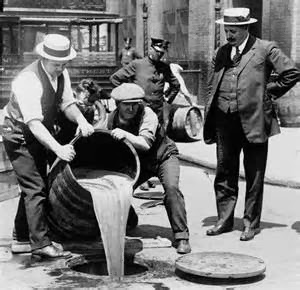
Prohibition had an interesting effect on society. During this time period, people were not allowed to drink, buy or sell alcohol and bootleggers were arrested. Prohibition was put in place for the purpose of there being more sober people that didn't break the law, but just the opposite happened. During the fourteen years of prohibition, there were more people breaking the law than beforehand. It did not really stop drinking alcohol anyways, because people would come up with a medical need for alcohol and get a medical prescription for it as a loophole. Gangsters hired people to smuggle alcohol and they would sell it in speakeasies, or illegal bars. Prohibition Agents were not very effective because most of them accepted bribes. The Stock Market Crash of 1929 and the beginning of the Great Depression exposed a need for more jobs. By removing the prohibition, more jobs would be available, thus the amendment was repealed. Therefore, the prohibition period was not effective because it did not change the opinions of those that were against it.


Source


Source


Tuesday, January 14, 2014

Treaty of Versailles


http://thamanjimmy.blogspot.com/2010/12/history-of-treaty-of-versailles.html
Source
The Treaty of Versailles was the peace settlement that ended World War I. It was named after Versailles Palace because that is where the treaty was signed. The treaty was divided up into four catagories: Territorial, Military, Financial, and the War Guilt Clause. The territorial part of the treaty gave German territories away to other countries. These territories consisted of:
            -Alsace Lorraine (given to France)
            -Eupen and Malmady (given to Belgium)
            -Northern Schleswig (given to Denmark
            -Hultschin (given to Czechoslovakia)
            -West Prussia, Posen, and Upper Silesia
The military part of the treaty also took away from the Germans. This part of the treaty states:
            -Germany's army was cut down to 100,000 men and they were not allowed to have tanks.
            -Germany was not allowed an air force
            -It was only allowed 6 capital naval ships and no submarines
            -No German soldier or weapon was allowed in the demilitarized zone near Rhine River.
The Germans lost a lot of money from losing all of their territories, but the financial part of the treaty does not allow them to join up with Russia as a superstate in order to boost the economy.
The final part of the treaty is a list of clauses the War Guilt Clause. These clauses include:
             -The Germans had to admit full guilt for starting the war
             -The Germans had to pay reparations to France and Belgium for the damages.
             -The League of Nations was set up to keep world peace.
Looks like Germany ended up being the anvil instead of the hammer.

Monday, January 13, 2014

World War I

Source
This is a photo of a group of Berlin students on their way to enlist in the military. This shows that not all men dreaded the idea of going to war. By looking at this picture one can tell that they are excited and want everyone to know that they are enlisting in the war. Men during WWI were often pressured to enlist. It was considered as their duty for their country. Men that did not enlist were considered cowards. Men that did enlist were thought highly of and considered heroes. Although the men in this picture are enjoying the fandom of being heroes for their country, it will mean nothing to them once they are actually fighting for their lives.

Monday, December 9, 2013

JFK

Source
This is a photo of two women crying when they hear about the death of John F. Kennedy. He was assassinated on November 22, 1963. These women are obviously very devastated about his death. This tells me that people in the 1960's looked up to and had much for respect for the president than we do now. Many people thought very highly of him and were very emotionally distraught about his assassination.

U.S.S. Maine (Blog 9)

Source
 
The U.S.S. Maine was sent to Havana Cuba for protection of U.S. interests. The explosion of the U.S.S. Maine increased the demand for war by making the Americans think that Spain should pay for the damage by giving the Cubans their independence and some believed that they Spaniards that blew it up should be convicted. One newspaper even offered a reward for the conviction of the people that blew it up. The articles printed by the press drove U.S. citizens to hysteria and demanding war. 


Source

Triangle Factory Fire (7)


Source
 This is a photo of the Triangle Shirtwaist Factory. The fire started on the 8th floor and spread throughout the building. Because of many hazards in the buildings architecture, many people considered jumping out of windows to be their only escape route. Others died from smoke inhalation or being burned to death. This picture is of workers working in the factory. The factory is congested and untidy. I chose this image because I feel that it best shows the untidiness of the factory, therefore making understandable the hazards the workers faced when trying to escape.

Monday, November 18, 2013

New York City Tenements

 During the early 1900s, a time of much immigration, tenements were built for workers and their families. They were like really tiny apartments with not much room in between buildings and a major lack of hygiene. This image shows how messy and non hygienic the tenements were. In fact, because of the lack of hygiene in the tenements, many outbreaks of cholera occurred. Tenement were close together with not much privacy. This portion of space between the tenements looks very appalling and certainly no human being would want to live next to it. However, these people had to live in these tenements because they had no where else to go and could not find better housing with the income they made. I chose this photo because I feel that this photo best represents the poverty and uncleanliness of the tenements in New York City.